Venezia


The day starts with the sound of wheels skipping over cobblestones and the gravelly voices of lifetime smokers greeting each other by name. Buon giorno. Buon giorno.
Shutters open and men and women appear, tugging. barking dogs of every size and colour down the street. More buon giornos. Little shopping bags of garbage are let down on strings from upstairs windows. They hang at eye level for the garbagemen to collect on their carts. People cluster outside caffès, a quick shot of coffee, chat and they’re off. The old men in their shirts and slacks linger, flirting with the waitress they know by name. Men in coveralls or worn clothes smudged with white jump down into boats and head off to work. They’ll be back at noon for a glass of wine or more. The produce vendor sets out the waxed boxes of fruit and vegetables along the gunwales of his barge. He stands amidst his wares while the older women trailing wheeled shopping carts stand on the shore and point. He hustles around, the wrought-iron guardrail of the canal providing a perfect foil for errant tourists who might try to lay their filthy hands on his fruit. The ladies trade euros for little plastic bags of zucchini with blossoms, plump artichoke, celery root, a handful of arugula.

Behind the vegetable man, a couple of boats jockey for position. The moorings are limited and assigned by the Comune. There is much shouting and pinching of fingers and waving. Venetians use their hands like highlighters because raised voices and words are evidently not enough to express their very deeply held beliefs about how one should park. The skill level of the boatmen is remarkable. A fireman drops off his uniformed colleagues on shore for an inspection and proceeds to do a three-point turn, backing his sleek twenty-foot power boat beneath a narrow bridge with boats moored on every square inch of wall on either side to turn around. He barely looks while he’s doing it. There are no bumpers on his or the moored boats.

I hadn’t realized before being here that there are no vehicles in Venice. Every street and alley and tunnel -- cobblestone and crumbling brick facades held together with bolts -- is pedestrian heaven but that does not mean that they are easy to navigate. Only a handful are as wide as any street of any other city, many narrow enough to loan your neighbour a cup of sugar without having to go outside. Most are strung with clotheslines. Everyone who is not a local (which is a huge majority of pedestrians) is carrying a map of some kind or following someone who is. Even with map in hand you can expect to hit a dead end several times a day. Much of the map’s dotted line indicating a passage is greyed out to show where you will be walking beneath a building. Setting a route is all about the bridges. Figure out which bridges you need to cross to get from A to B and work your way back. 117 islands make up Venice and there are a dozen in our neighbourhood alone. Not every street leads to a bridge and not every bridge leads anywhere. Some stop at someone’s front door and because they can be quite steep, you often can’t see where the bridge lands until you’re across it and performing an embarrassed about-face. The paths alongside the canals inexplicably stop. Enticing archways, lights at the end of tunnels, unceremoniously end with mossy steps dropping into the milky, pale green water. Little minnows everywhere. You can tell that this city invented itself one reclaimed foot of marsh and one house at a time. Every corner offers a vignette – a young woman goldoliera punts her boyfriend around the canals, expertly making way for oncoming boats; construction workers haul lumber and stone to worksites, transferring them from boat to handtruck for the walk to work; university graduates, crown of plastic laurel on their head and bouquet in hand, parade by trailing a group of proud friends and family.

The bridges are magic, each one unique. Pale stone or peach-coloured brick or wood, the arches gracefully straddle the smallest and the biggest canal and everything in between. Off the beaten path, the bridges are meeting places for Venetians running errands or humping strollers up and down the stairs. The island portion of the city, about 5 square kilometres is home to only 55,000 full-time residents so it’s no wonder they all seem to know one other. In the more touristy areas, the apex of each bridge is packed with families or couples posing for each other, the photographers pausing to let other tourists or irritated locals by. Some areas have very few bridges which creates bottlenecks, making it almost impossible to avoid heading back toward the grand canal and its crowds to get across town. Which is where the vaporetti shine. The vaporetti (Italian for little steamers) are the waterbuses of Venice and have been plying these waters since the 1880’s. The shores of the big canals are dotted with stations which consist of a machine to purchase tickets and a little, yellow, floating waiting room with one side open on to the water. The little barges pull up alongside the station wharf which the ticket taker catches with his rope. He briefly ties up and rolls back a long stainless door, letting tourists and commuters off and more tourists and commuters on, before swinging the door back and untying. The barges are variations on a theme with windowed seating like the metro and sections open to the outside for gaping. The boat hopscotches from one side of the canal to the other, past grand palazzos with wide stone steps leading down to private moorings. Domes of basilicas and palaces and leaning bell towers glowing in the distance gives the distinct impression one has been copy-pasted into an 18th century painting. I don’t know if it’s the ever-present water diffusing the sun, but in Venice it seems like magical sunset light every hour of the day.

The Biennale is dizzying. Even in four full days it would be impossible to see all the art that is here for the season, never mind the endless museums that provide homes for countless collections year round. Most of the Biennale is housed in the Arsenale and the Giardini, along with a smattering of collateral shows all across the city. The Arsenale, a former shipbuilding complex of pale red brick is a massive industrial structure with a further series of smaller spaces strung in arches along the Arsenale basin. The Giardini, a ten-minute walk away, is a green space dotted with fragrant trees and almost 30 national pavilions -- one-story structures of every architectural style showcasing that nation’s offering -- along with the Central pavilion, an acre of space displaying art that reflects the theme of this year’s biennale. Chosen by the curator of this year’s show, Cecilia Alemani, the theme was inspired by the surreal universe created by Leonora Carrington on the walls of her boys’ bedroom and later in her book, The Milk of Dreams. 90% of the artists at the biennale are women and there is a very definite and refreshing emphasis on historically under-represented peoples. The work ranges from massive room-sized sculptures to post-card sized paintings. Eccentrics from every nation are here with us, flying their freaky flags with sequins and stripes or all in black with heavy-framed glasses every colour of the rainbow. Art students on school trips wander around in cliques, giggling, trying hard to be visible.

The highlight for me was the Belgian pavillon with Francis Alys’s short films of childrens’ games from all over the planet and his lovely, delicate postcard-sized paintings of street scenes from the towns where the films were shot. It was impossible not to smile watching the kids lost in their little world. The films are all online at http://francisalys.com/category/childrens-games/
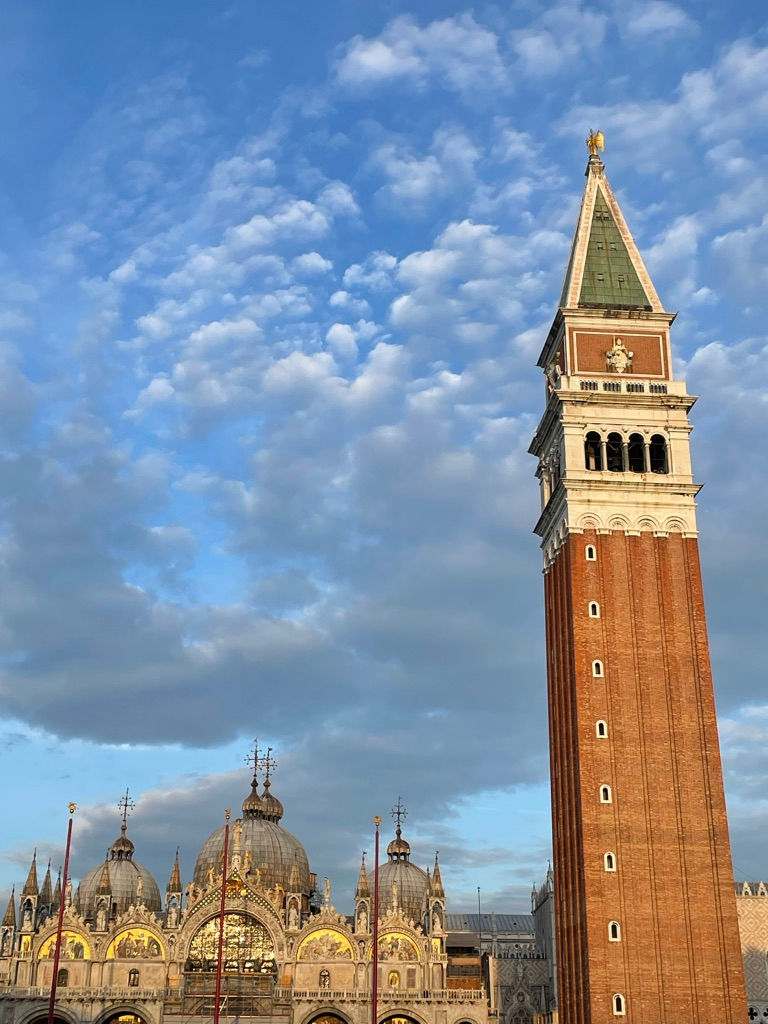
Some of the biennale’s offerings are in spaces around the Piazza San Marco. As we enter one of its main buildings, the Palazzo Ducale, a trip to the bathroom brings us next to the gates that open out onto the Rio del Palazzo canal. The water laps the steps right through the giant doors, a reminder of just how vulnerable Venice, which sinks a millimeter every year, is to the rising seas. The Piazza is barely above sea level and its storm drains empty directly into the Grand Canal. In Acqua Alta (high water) events when high tide and storm surges combine, the canal surges back through the drains to flood the square. Thankfully, the square is dry for now. We’re here to visit the behemoth tableaux of Anselm Kiefer. The giant 30 x 24 ft canvases are imposing. They feel more like mood than colour, marshes meandering off into the mist, Jacob’s ladder climbing skyward, the lid of the casket of St. Mark hanging open high above us. The artist’s nod to Venetian history almost reaches the ceiling in one of the biggest rooms of Europe. The portraits of the Doges, the former magistrates of Venice, are the only things still visible on the wall behind, a ring of smurf-hatted heads poking over the top of the paintings. I wonder if they would approve.

The only wheels in Venice are the handcarts, in the hands of garbage men, wine deliverers, construction workers. I couldn’t quite come to terms with the jarring anachronism of seeing one piled high with Amazon packages and being wheeled through medieval walkways. Every “street” wider than a dozen feet has tiny tables of two set out, a pair if it’s tight, in rows where the passage widens. Tabletops covered with glasses of Aperol spritzes and plates of cicchetti, the Venetian form of tapas – slices of bread or polenta topped with brandade or prosciutto and cheese, along with other finger foods. Pigeons weave around doorways and nip into storefronts, dodging the waiter or storeowner with practiced evasive manoeuvers. Little mosquito coils burn under every table.

The four eight-hour days of art, insterspersed with molti vino bianco, pass in a flash. We catch the Alilaguna, the airport waterbus, back to Marco Polo. Like the vaporetti but all seated indoors, the boat chugs along, slowing down when watertaxis whip past so we don’t get bounced too much in the wake. Circling the city we get to see where the canals emerge from the city into the lagoon and watch the boatmen disappear into the sinuous channels. We drive past the hospital and watch paramedics unload a patient from an ambulance boat on a wooden handcart that looks like it’s been in use for two hundred years.

Venice was essentially a hideout for residents of the mainland fleeing successive raids by Germanic tribes and the Huns in the 5th century. The lagoon was famously impossible to navigate. While the invaders were on the march, the locals would hole up here, eventually tiring of the back and forth to the mainland and settling in. The republic of Venice, a city state founded by refugees, became a maritime powerhouse of the Mediterranean and was a hotbed of commerce between east and west for a thousand years. Much of the lagoon, the shallow wetland surrounding Venice, is less than 2 metres deep so trios of wooden pilings called bricole delineate the dredged channels where all the traffic circulates. Slower boats like the Alilaguna run close to the outside of the channel while the sleek, swifter watertaxis charge up and down the middle. What lies beyond the bricole is an endless chain of islands, flat, clumps of brown grasses that are barely peek above the water. I imagine much of the lagoon looked like this before the Huns. The notion of pounding oak stakes into this silty marshland and building stone footings atop them seems like such an unlikely foundation for a jewel of a city and yet here it is, in all its shimmering glory.
Arrivederci Venezia.


Comments