Gaspésie

Colourful towns strung along the shores. Steeples and silos the only things vertical. Wil wonders what the first peoples' reactions would have been to these constructions while I wonder which came first, the steeple or the silo. The mountains on this side of the fleuve look like someone dumped a bucketful of sand and seeded it, or they're giants who've buried each other in the sand and drifted off to sleep, forever. The greenery has grown over them but it still seems they might emerge and shake off the sand at any moment. We drive through high plateaus, farmland dotted with white houses and haying equipment planted in fields every shade of green. Vast expanses of bright yellow canola flowers look like crushed velvet, gold and green sweeping down into the valley. Farmers' fields are anything but flat, a magic carpet ride, each tract separated by darker brush, rolls down to the river's edge. The smell of the sea fills your senses. A deep inhale and you feel like it'll never leave you.

The houses on the shore are modest, to say the least. The cheapest of building materials stretched well past their shelf life. The churches, in contrast, are ornate behemoths. I can't help thinking that if the money that had gone into the offertory baskets had stayed in the hands of the parishioners more of the original homes might still be standing. The occasional one sits lonely in a field, silver shingles listing, windows smashed, tired clapboard trying to lie down in the grass.
Daubs of bright colour are everywhere — patches of fuchsia and deep purple and canary yellow. Tiny, unassuming blossoms that would barely draw attention to themselves on their own become a deep lake of solid colour adorning ditches and fields. The drive along the 132 past Matane is spectacular. The mountains just drop into the fleuve. The hillside is so steep, covered in fine gravel or sheer limestone. Layers of rock jut skyward or are jumbled in whorls by violent continental collisions.

Le Bic, now merged with Rimouski, is a tiny village, the shoreline dotted with islands like the famous ones in Vietnam. Our auberge is a labyrinth of creaky little rooms filled with furniture that looks like it was bought up when the local convent closed down. Tall small-paned windows set into dormers, the floor is a slope, the bathroom comically small.

After a terrific dinner we walk up the side of the hill that frames the town, through a pretty little park carved out of the woods. At the top, a canon points seaward and Jesus hangs above it all, his cross lit up so he is visible from everywhere. The sides of the statue's base are inlaid with memorial plaques, one for a young man charged with firing off the canon for a salute during a cardinal's visit. Impatient, he tried to reload before the gun was cool and went up in a puff of smoke.
We spend the next morning at the gorgeous Jardins de Métis. Meandering flower beds that weave in and out of the woods. Contrasted with what seems to grow naturally here — ferns and more ferns in acid soil on abrupt slopes lope into stream beds — the achievement is all the more impressive. The fact that Elsie Reford began this project at age 54 is certainly inspiring for this 52-year-old. She took up gardening because her doctor suggested it would suit her health better than salmon fishing, which was her passion. There is more than one photo of her standing in a canoe in a full-length skirt, waist cinched and bustled, a rod in hand, face plastered with a smile.
Primroses, hellebores, peonies. They are more than a month behind. The growing season must be painfully short here.

We have lunch at the Villa Estevan — the Reford house, Elsie's former summer abode. It's big but not at all grand. No fancy joinery or millwork here. The whole thing is tongue and groove western cedar, the bedrooms have rough pine plank doors. I imagine her uncle, who left the place to Elsie, must have employed the locals to build it. The meal was spectacular. Great flavours, perfect execution, lovely colours and yummy wine pairings. Wil dozed under a tree while I perused the museum upstairs and read up on Elsie's life. How frustrating it must have been — an intelligent, ambitious woman of means and to have one's talents and energy wasted on dinner party placement.
Back in Le Bic, we walk down Golf Club Road toward the Pointe des Anglais, a little dirt track that rolls toward the river, for the sunset. The clapboard or shingle houses here are slightly grander and older — big wraparound verandas and dormers designed to take full advantage of the river views. We read that this was one of the first permanent settlements in Quebec, young mariners were stationed here to guide vessels through the dangerous waters around Le Bic. Those first winters must have been intense. The road's name and those of the houses along it seem to be the last vestiges of anything remotely anglo in Rimouski, aside from the young women employed by our auberge who both hail from Ontario.
The rocks at the end of the point are like nothing we've seen before — a fusion of smaller rocks glued together by time and pressure. Little holes eroded in the softer rocks are colourful puddles teeming with creatures living their entire lives in these two gallons of water.

A little island across the bay is called Ile du Massacre. A band of 50 or so Mikmaq families, the story goes, took refuge from the Iroquois here, hiding in a cave and concealing the entrance with branches. Unfortunately for the Mi'kmaq, the Iroquois also knew about the cave and set the branches alight, trapping and killing all but five of the Mi'kmaq. The Iroquois version of the story has the Mi'kmaq hiding in the cave with Iroquois women captured in a raid. As usual, history depends so much on who's doing the telling.

The next morning we head toward Anse-au-Griffon, taking little detours off the main road to see more of the coast. We stop to take a tour of the Onandaga submarine, skirting past the couple of families stalled at the first numbers on the audio tour so we manage to get through the submarine completely alone. It is a claustrophobe's worst nightmare. The berths don't look long enough for a full-grown man. The engine room is called the snakepit because you can only get around by shimmying along the floor under the roaring diesel engines. No thank you. We drive on, through Métis sur mer, an affluent community with landscaped grounds and the grandest houses on the peninsula perched along the water. All the road signs and house names are in English — a throwback to a Scottish seigneur who filled the town with his countrymen. A sober little Anglican church is tucked into a tiny lot on Main Street.

We stop again, this time in Ste-Flavie, a village with a gigantic church wrapped by a cemetery that overlooks the fleuve. It was considered a good omen, the panel reads, that a 14-month-old Mi'kmaq girl be the first one buried on the grounds, as she was without sin. Probably without decent health care, too. Catholicism is so weird.
The villages have seen better days and with the temperature barely breaking 15 it's hard not to imagine the wind just howling in in the winter. The road must be impossible to keep clear of snow. The newer homes look flimsy. Impossible to heat, no doubt. The walls facing the road are often piled high with dozens of cords of wood. It's late July and we're wearing every layer of clothing we've brought (seven, if you're counting). As a Gaspésien old-timer once told Wil, "It's a bit cold here all the time."
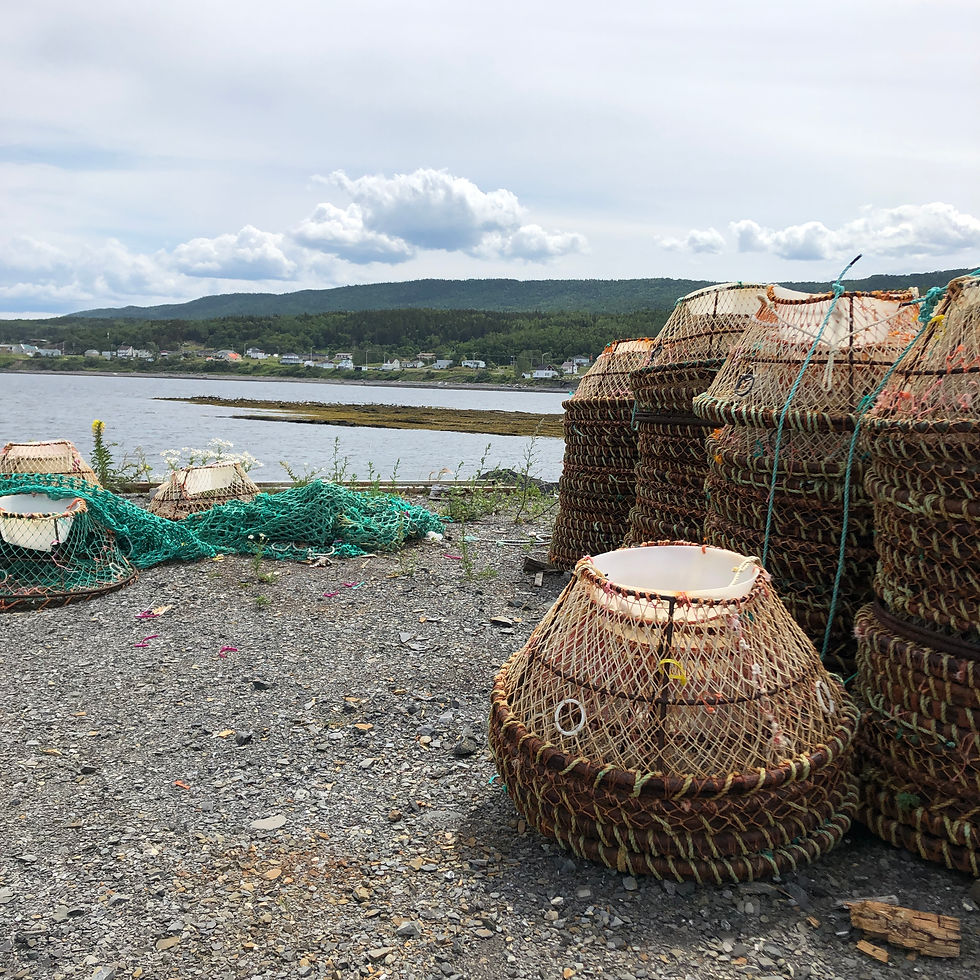
We stop for a delicious seafood guédille (a hotdog bun loaded with, in this case, shrimp salad) on a fishing dock and the tourists who emerge from their cars in shorts and flip flops last about five minutes in the cutting wind before heading back to their vehicle for more clothes. The locals are dressed in very little. Summer weather is, after all, a relative thing.
We make it to Anse-au-Griffon and put up our tent in the woods. The owners here have come up with a winning set up; a communal area overlooking the ocean, picnic table, adirondack chairs and firepit. Just above that, a terrace with old school bus benches and tables, a full bar, an industrial communal kitchen, a food truck and indoor lounge areas. Farther back the bathrooms and beyond, a network of paths lit by solar lamps leading to cabins or tent spots that are practically on top of one another but separated by dense woods so they manage to feel quite private. The whole thing is probably on four acres. They recouped much of their building supplies from falling down barns. It is funky and functional and affordable.
The star attraction however is, without a doubt, the fleuve. Immense and flat and teeming with life. Constant entertainment. It's like a highway for the waterbirds who skim along the surface heading east at sunset. White gulls bob on the water in a long line that rises and falls like a breaking wave. Right below them, a small pod of whales, invisible but for the plumes of spray that lift off the water like smoke. They are feasting.

We tramp down the steep steps that lead to a twenty-foot wide pebbly beach between the sea and the cliffs that hang above it. A walk on the bumpy shore yields more marvellous rock — huge golden slabs shaped by the tides into fins. The pebbles on the beach either look like modernist creations — buttery-soft slate crisscrossed with bright white stripes or rough earth-toned granite. The geology is on full display as spines of harder rock cut across the beach and make their way up the cliffside.

We drive to Gaspé (Gaspeg, "end of the land" in Mikmaq) in the morning and then on to Percé. The road is all drama, mountains of inky spruce and fir, bluffs of terracotta rock that look like wounds gouged out of the hillside. The 132 hugs the coast — hundreds of tiny hamlets named after every lesser-known saint. I suppose the big cities got first dibs on the stars of sainthood. But St-Pacôme, Saint-Agricole, Saint-Moses. Saint-Narcissus? They're making them up! Each village straddles one or sometimes two rivers. Huge, wild-looking things shimmering in the early morning sun. The volume of fresh water feeding the sea from the Gaspé rivers alone is gobsmacking.

We head toward Carleton-sur-mer — taking the long way round — opting to retrace our steps west on the northern 132 and then cutting across the peninsula through the Chic Chocs. The views continue to wow. Crazy how a little sunshine makes everything pop. Each point we come around reveals a cluster of homes nestled around a bay. It's obvious the homes predate the roads as there isn't a straight one among them. We're driving out of the sunrise and at first glance the houses in each new village look like a gaggle of ladies sitting at a café on spring's first warm day, each white face straining toward the sun.
There are so many rivers. When you're driving a motorcycle there is only so much attention you can devote to things other than the road and in that absent state of mind I'd convinced myself that the rivers were all one and the same. Rivière à Saumon. Not entirely sure why they feel the need to identify the salmon rivers — special treatment for spawning grounds or a helpful guide for anglers? As we weave in and out of coves and around a hundred points it becomes even more unfathomable that these fish are able to navigate the ocean, make their way up this craggy coast and pinpoint the place they first saw the sea. When you see the incredible volume of water flowing down these waterways it's even more inconceivable that they make it back to the place of their birth.
We drive through so much fir and spruce, the hills towering above us. And above the hills tower the wind turbines. The wood and lakes are so wild that when a wind turbine, in all its glossy, mechanical perfection, appears over the top of a hill it may as well be Godzilla.
We saw disassembled turbines making their way down the 132 yesterday, complete with NY state trooper escort. An eighteen-wheeler cab holding one end of the mast and another, separate set of wheels pulling up the rear fifty or more feet back. The next day it's one of the propellers that glides by — all the traffic pulling over to the shoulder to make room.

When we get back to Ste-Anne des Monts we hang a left into the peninsula to cut across to the Baie des Chaleurs. It doesn't take long for the scenery to change. A wall of mountains, complete with snowy caps. The Cascapédia river, a few times wider than the road, sparkles in the sunshine, the water white as it lunges toward the sea. Fly fishermen stand waist-deep in the racing, bracing water trying their hand. An angler almost catches more than he bargained for as Wil ducks to avoid a lure flicking across the road right past his head. The tiresome, constant wind is gone. The sun is beating down. We stop to take it all in and peel off all but two layers. The road is perfection — like a postcard of Canada's wild rivers — the majestic Chic Chocs filling half the blue, blue sky with green.
Easing down to the Baie des Chaleurs coast, the houses get bigger and older — clapboard and shingle, pastures cleared, tidy farms. You definitely get the sense that farmers had an easier time of it than the fishermen of the north coast. The village church is a modest structure. Anglican. Chastity, poverty and obedience for the Catholics. For the Protestants in contrast, as Wil puts it : "Get rich and cut us a cheque".

The temperature is 15 degrees warmer. People are actually IN the water. Suddenly it's summer again. We find our friends in their family compound at the end of a rutted track. A long line of rosebushes mark the edge of the deck and a narrow set of wooden stairs cut into the hill lead down to the bay. Like a scene out of the Beachcombers, the sand is littered with driftwood, dried mats of seaweed of all colours and more rocks. The water is warm enough for most (not me). We spend a couple of days lounging in a driftwood shelter out of the sun, cooking up lobster and shrimp and halibut, throwing the ball for the tireless Hannah. We dig clay out of a nearby pit and fashion little pots to fire over a little grill. We feast on striped bass that throws itself onto the hook.
And then it's over. A marathon 880 km on the blustery 20 and we're back in Abercorn.


Comments